
Lakkaya Palmer
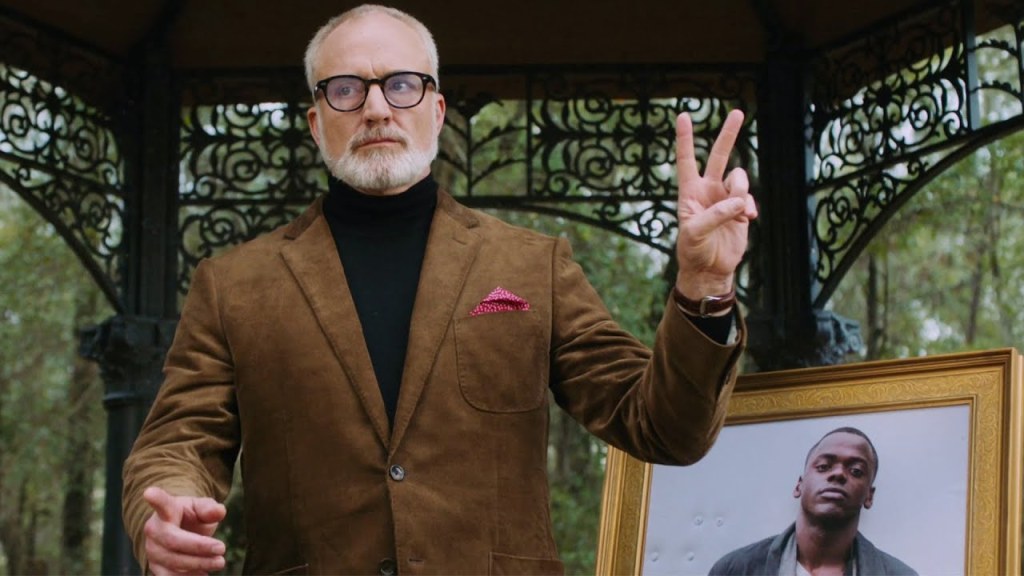
The black body in American horror cinema becomes a spectacle in many ways. One which is treated as a site of consumption for, typically, a (white) symbolic cannibal who seeks to consume the black body for their own benefit. For example, Jordan Peele’sGet Out (2017) reveals the Symbolic Cannibal in the character of Dean Armitage (Bradley Whitford), along with his wife Missy (Catherine Keener) and two children, Rose (Allison Williams) and Jeremy (Caleb Landry Jones), who kidnap and steal black individuals (mainly black men) and implant their bodies with white consciousness. However, it is not just the Armitage family who engage in this, but a wider network of primarily upper-class white individuals. Midway through the film, audiences realise that these same networks of wealthy elites were bidding on the body of Rose’s ‘boyfriend’ Chris (Daniel Kaluuya).
In the film, the Symbolic Cannibals (in this case, the Armitages) are metaphorically consuming black bodies as they desire the vessel of the black body, but still believe in the superiority of white consciousness. In this way, the Symbolic Cannibal Dean takes what is not exclusively his (the black body), wanting it for the perceived positive attributes, such as its physicality, whilst still perpetuating the ideology of white superiority. This has ties to older horror films such as Wes Craven’s The Hills Have Eyes (1977), with The Carter family symbolically consuming, economically speaking, at the expense of the racially-coded ‘hill-dwelling’ family (who themselves are then coded as the literal cannibals). The white patriarch of Get Out exhibits similar greed and consumption habits as he seeks to profit and benefit from those who are marginalised. The tradition of the black body and being a site of literal and metaphorical cannibalism also ties to George A Romero’s Night of The Living Dead (1968) as the zombies seek to eat those who are living. While the heroic black protagonist Ben (Duane Jones) survives the Zombie threat, he is shot dead at the end, symbolically consumed by the white men in power.
‘black bodies are in revolt against the symbolic cannibal’
Drawing on these long-standing horror motifs, Get Out responds directly to its contemporary contexts. The film was released directly after the Trump election campaign, with racial tensions further heightened within American society. Likewise, Trump mimicked Reaganite ideas regarding race and economics, demarcating consumption and excess as a privilege of whiteness, gatekept by a wealthy, predominantly white American elite. The symbolic cannibal therefore sees a resurgence in contemporary horror. However, rather than these Symbolic Cannibals being steadfast in their conservative ideals, in the same way the Carters were in Craven’s Hills, Get Out’s Dean Armitage hides his monstrosity under the guise of liberalism. When he first meets Chris, he code-switches, calling him ‘my man’. Dean also states that he would have voted for Obama a third time if given the chance, illustrating that the black body is used as a tool by those who seek to consume it. Yet, the horror of those who seek to consume it is no longer exclusive to the conservative and traditional but can easily be hidden under a progressive mask of liberalism.
Dean is a figure who consumes and profits from marginalised people (in this case, the auctioning of Black bodies); his authority is challenged by the marginalised (in this case, Chris); and he engages in violence against his the black victims, transferring white consciousness into the Black body. He transfers these ideals to his children, yet unlike the long-standing horror tradition of the black character being murdered, the Armitage’s fail to murder Chris, who escapes and reigns somewhat victorious. They fail, partly because Chris uses tools that would have otherwise rendered him powerless in society (such as cotton from the chairs he was chained to block out the sound that causes hypnotism) to aid his escape and eradicate the Armitage family. Chris also becomes ‘The Final Boy’, showing how race and gender dynamics have evolved since Clover’s theory of ‘The Final Girl,’[1], which we first see in Tobe Hooper’s The Texas Chainsaw Massacre (1974)with Sally Hardesty (Marilyn Burns). By allowing Chris, as a black man, to survive, Peele empowers the character, who otherwise would have been powerless in the face of persecution.
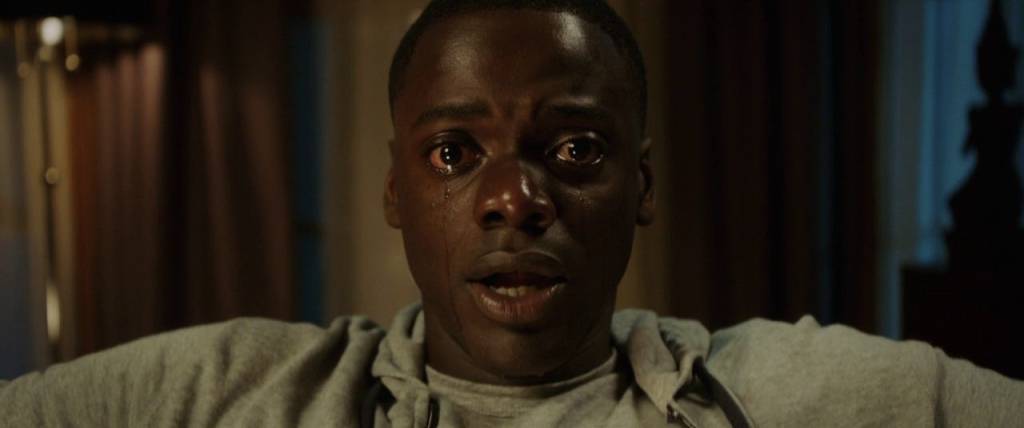
A similar tool is used in Juel Taylor’s They Cloned Tyrone (2023) (a nod to the blaxploitation films of the 1970s). They Cloned Tyrone transforms the stereotypical black archetypes of the drug dealer, Fontaine (John Boyega), the ‘whore’ YoYo (Teyonah Parris) and the pimp, Slick Charles (Jamie Foxx) into heroes.[2] They can free and empower themselves against an oppressive government who are cloning and controlling black communities. This connects directly to the legacy of Peele, showcasing black anxieties about white exploitation. The working and exploited black classes fight back and win against their oppressors who are predominantly white, with the ‘older’ version of Fontaine, who had become convinced that ‘assimilation is better than annihilation’, providing an apt commentary on the beliefs about race in contemporary America. Despite this, even though Fontaine is positioned as violent, he is also intelligent. He is the catalyst for black victory towards the end of the film, despite the fact he still has to live with the reality that he is a clone. New Wave Black films such as Get Out and They Cloned Tyrone illustrate that black bodies are in revolt against the symbolic cannibal, and the traditionalist structures, oppression and degradation they represent.
Bio
Lakkaya Palmer is a PhD student at University College London, researching representations of fatherhood and masculinity in American Horror Cinema under the ‘Fercious Fatherhood’ framework. She is also the co-director and screenwriter of the short horror film The Shedding (2024). She has contributed to Moving Pictures Film Club, Ghouls Magazine and Headpress. You can find her on X @LakkayaP
[1] Carol J Clover, Men Women and Chainsaws: Gender in Modern Horror Film (New Jersey: Princeton University Press, 1992)
[2] Uwa Ede-Osifo, “How ‘They Cloned Tyrone’ transforms racial archetypes into unlikely heroes” NBC News (2023) https://www.nbcnews.com/news/nbcblk/-cloned-tyrone-transforms-racial-archetypes-unlikely-heroes-rcna99104 [accessed 23/01/2024]
 Cinema and Social Justice PROJECT
Leave a comment