
Claire Henry
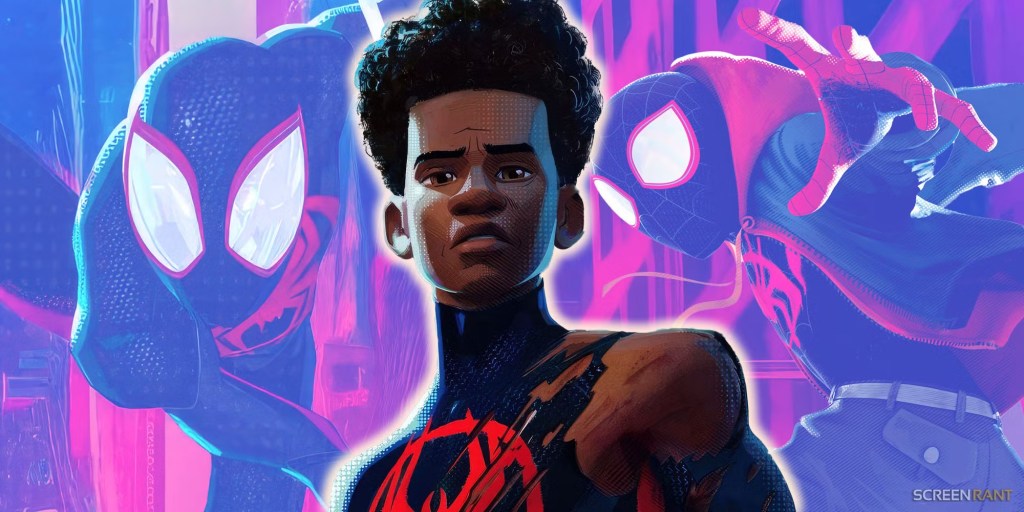
Spider-Man: Across the Spider-Verse (2023), (SMASV), is an artistically stunning sequel to 2018’s Into the Spider-Verse, which follows biracial teenager Miles Morales as he navigates both the multiverse and his identity. Miles, an African-American and Puerto Rican young man from Brooklyn, embarks on adventures while dealing with the pressures of his mixed identity. His journey mirrors challenges that many mixed-race individuals face, balancing different identities while remaining true to himself. The film’s portrayal of biracial identity provides audiences compelling insight into the real-world experiences of mixed-race individuals.
Mixed Identity is Multidimensional
Race is omnipresent in one’s personal identity. Being mixed-race, I’ve struggled with societal expectations of the multiple “races” I represent, often being asked the daunting question, “Where are you from?” It’s a multiplex question many individuals have a hard time answering accurately in a few words. My multiracial background (White, Black, Hispanic and more) makes me acutely aware of the social pressures surrounding racial identity (which includes hours of family discussion), inevitably landing on “Creole” for myself.
Researcher Theressa LaBarrie’s “Multidimensional Model of Biracial Identity” is one of the best theories I’ve come across to understand how one’s claims of multiracial and single-race identity differ. She describes four ways mixed-race individuals may identify: Singular (recognizing one race), Border (acknowledging multiple races), Protean (fluidly switching between identities), and Transcendent (rejecting racial classifications). Many, including myself, relate to the Protean and Transcendent Identity concepts, embracing racial fluidity while forming a unique sense of self. As much as I resonate with this theory, I propose an alternate scheme to categorize identities: genetically (DNA), external (appearance), and mental (cultural upbringing and outlook). This allows for the exploration of an identity that goes beyond race, something I see reflected in Miles Morales’ journey.
Multiracial Identity through Artistic Choice
The film’s artistic choices of comic-book textures and watercolor aesthetics in each universe play a significant role in conveying the complexities and internal struggles of mixed-race identity, exemplified by two Miles of different universes. One Miles is raised by his Black father and Latina mother, and the other is raised by his Puerto Rican mother alone. This difference reflects in the characters’ language, accent, and cultural immersion. Earth-42 Miles, who lost his father, displays a stronger connection to his Puerto Rican heritage.
This resonates with many mixed-race individuals who may wonder how different their lives would be had they grown up in a different cultural environment, addressing societal pressures to conform to a singular racial identity, but also emphasising the beauty and strength in embracing the complexity of being multiracial.


Earth-1610 Miles is depicted in vibrant, comic-book style visuals, reflecting his creative and optimistic nature, while Earth-42 Miles is drawn with darker, more rigid lines, implying his gritty, more somber upbringing. This contrast emphasizes the impact different upbringings have on shaping identity.
Music as a Reflection of Identity
Music is another powerful tool the film uses to represent Miles’ dual identity. From R&B to Afro-Latino tracks and artists, the soundtrack reflects the fusion of cultures, much like Miles himself. Music has been a crucial part of my own multiracial experience, and is central to Miles’ character development. The soundtrack, like that of Black Panther (2018), plays a significant role in advancing the film’s celebration of diversity.
Challenges of Media Representation
True representation goes beyond mere tokenism; it demands a commitment to crafting new narratives that authentically portray diverse experiences and characters, rather than simply substituting races as a superficial gesture towards diversity. SMASV avoids superficial diversity by grounding its story and its aesthetic decisions in the exploration of Miles Morales’ biracial identity, showing the studio’s commitment to a more authentic representation. While the film authentically portrays mixed-race identity, the industry still struggles with genuine representation overall.
Family and Cultural Humility
Family and community are key to shaping multiracial identities, which are deeply explored in SMASV. The support of Miles’ parents, particularly their encouragement of his cultural exploration, reflects the concept of cultural humility—a parenting style that encourages mixed-race individuals to embrace their multiple heritages rather than conform to a single racial identity. The film poignantly highlights how multiracial individuals can thrive with support and understanding from their families in contrast with the harmful notion of colorblindness, which ignores the real struggles of navigating a mixed-race identity.
Miles Morales’ journey is a powerful reflection of the complexities of multiracial identity. Through its nuanced storytelling, striking visuals, and culturally resonant soundtrack, the film offers a thoughtful portrayal of what it means t#o be biracial in a world that often pressures individuals to conform to a singularity.
As media evolves, we can advocate for films to feature diverse characters and explore the deeper complexities of identity. These multiracial stories offer visibility and validation, showing that our identities, like Miles Morales’, are multifaceted, fluid, and deserving of celebration.
Claire Henry is a Californian native in her 4th year, pursuing a Master of Arts Honors undergraduate degree at the University of St Andrews in Film Studies and Sustainable Development. Her research interests span Racial Justice, Feminist Studies, Eco-cinema, and sustainability within the film industry. Currently, she is working on her honors dissertation, which explores how gender diversity in leadership roles within film production fosters more sustainable workspaces and ethical storytelling.
LinkedIn: www.linkedin.com/in/clairelhenry
Facebook: https://www.facebook.com/clairee.henryy/
Bibliography
Bowles, D.D. 1993. Biracial Identity: Children born to African-American and White couples. Clinical Social Work Journal, 21(4). pp. 417–428.
Gonzalez, Anika. 2023. “Into the Spider-Verse: Cultural Identity in Spider-Man Media.” Into the Spider-Verse: Cultural Identity in Spider-Man Media. May.
L. LaBarrie, Theressa. 2017. “Multiracial Identity Development: Illuminating Influential Factors.” North Western University: The Family Institute at Northwestern University.
Santos, Joaquim Dos, Kemp Powers, Justin K. Thompson, Phil Lord, Christopher Miller, Dave Callaham, Shameik Moore, Hailee Steinfeld, and Brian Tyree Henry. 2023. “Spider-Man: Across the Spider-Verse.” IMDb. June 2, 2023. https://www.imdb.com/title/tt9362722/.
Vincent, Harvey. 2019. “Seeing Me in the Story: Representation of Multiracial Characters Seeing Me in the Story: Representation of Multiracial Characters in Multimedia in Multimedia.” The Vermont Connection. University of Vermont.
Weaver, Jamie, and Azadeh Masalehdan Block. 2020. ‘Identity Development in Biracial Children: Contextual Factors from Social Work.’ Keystone Journal of Undergraduate Research 7 (1): 13–22.
Filmography:
Santos, Joaquim Dos, Kemp Powers, and Justin K. Thompson. 2018. Spider-man Across the Spider Verse. United States: Sony Pictures Home Entertainment. Online. Coogler, Ryan. 2018. Black Panther. United States: Walt Disney Studios Motion Pictures. Online.
 Cinema and Social Justice PROJECT
Leave a comment