

Deirdre O’Neill
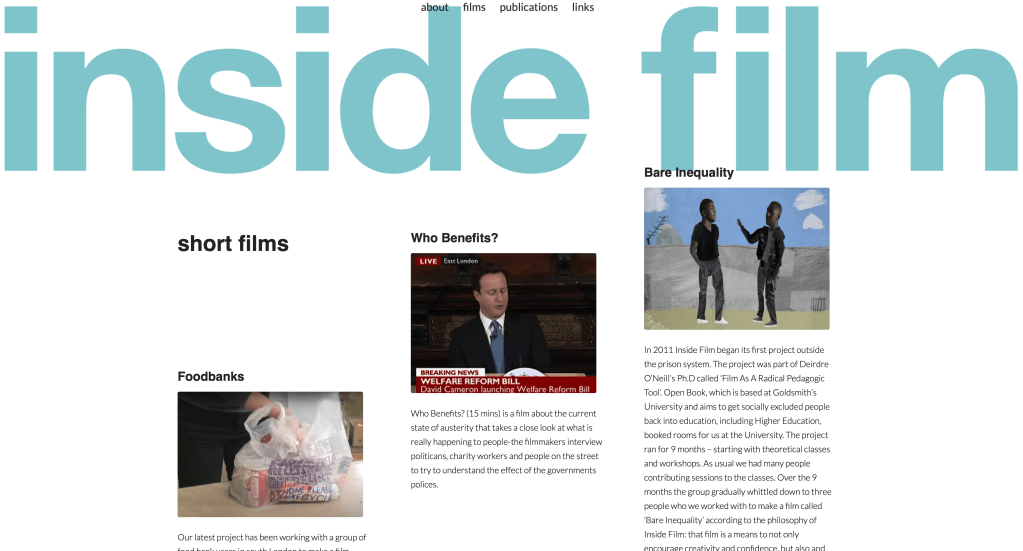
The Inside Film Project runs both inside prisons and on ‘the out’ working with serving and former prisoners. It recognises the majority of serving prisoners in the UK come from the most marginalized and impoverished sections of the working class. The project begins from an acknowledgment that working-class knowledge has long been denigrated or ignored rather than recognised as a site of intellectual production, and that the working class have been, and continue to be, treated as objects of study. By positioning the participants as creators and interpreters of their own stories, the project engages directly with issues of social justice, challenging systemic inequalities in both the justice system and media representations.
Through the process of filmmaking, Inside Film situates the working-class not only as subjects and filmmakers but, crucially, as interpreters of their own experiences. In doing so, it challenges the structural inequalities that define whose stories are told, and by whom. Drawing on Russo and Linkon’s [LS1] concept of intellectual activism, [1]the project aims to build bridges between the academy and the street, and between scholars and radical movements. It recognises hegemonic forms of power and knowledge function to oppress and dispossess, while oppositional forms are vital to social struggle and transformative politics.
The project represents a sustained engagement with working-class experience, consciousness, and culture. It directly confronts dominant narratives around justice and imprisonment, exposing how prisons are represented in the mainstream media —either as institutions of ‘rehabilitation’ or violent spaces inhabited by violent people, thereby reproducing class stereotypes.

Film here functions as radical pedagogy: a space for participants—both inside and outside prison—to develop critical awareness around representation and class. The emphasis on working-class perspectives goes beyond depicting conditions of poverty or marginalisation; it bears witness to how class is lived, embodied, and narrated. Typically, working-class lives are authored by others—filmmakers, politicians, educators, journalists, members of the legal profession—almost all drawn from the middle class and largely insulated from the experiences they depict. Without power over their own representation, working-class people are voiceless, their actions decontextualised and reinterpreted to fit pre-existing stereotypes.
The Inside Film Project resists any oppressive/paternalist dynamic through participatory film practice. We run idea sessions where participants develop scripts and storyboards; camera and editing workshops provide practical skills; and theoretical and personal discussions open space for political engagement. This integrated approach challenges dominant stereotypes of the intersection of class and crime, claiming authority from a position of otherness and intentionally supporting subversive storytelling which disrupts hegemonic narratives.
The project establishes critical spaces for engaging with ideology and the lived experiences of the working class—spaces in which participants explore how politics, power, and institutions such as prisons are represented and understood. In this context media literacy becomes a form of political education and a tool for social justice.
Film, as a familiar cultural form, becomes a means through which participants already immersed in popular culture can learn to critique and produce media texts. Through the integration of dialogue and filmmaking, the project nurtures shifts in political consciousness. The lived experiences of prisoners become a legitimate site of knowledge production. As participants script, perform, film, and edit their work, they move beyond surface meaning to demystify the process of filmmaking itself. Coming to understand film as constructed; shaped by aesthetic, cognitive, and political choices.
Yet within progressive and cultural institutions, Inside Film confronts tensions. We have found self-described ‘radical’ filmmakers reluctant to engage in discussions of class; in the charity sector, cultural production often functions as a vehicle for the imposition of ‘legitimate’ culture, offering ‘cultural provision’ that cloaks rather than confronts inequality. Such approaches neglect the class-based alienation and deprivation that underpin much of what society depicts as working-class ‘crime’.
Powerful corporate, political, and media structures collude in erasing working-class stories and silencing their voices. The working-class academics and filmmakers involved in the Inside Film Project advocate for film as a political process developed alongside the prisoners who take part in it—not as a route to assimilation into middle-class norms, but as a means of authoring their own stories. By reimagining concepts, practices, and methodologies, the Inside Film Projectrefuses the dominance of middle-class cultural assumptions, foregrounding instead the lived experience, knowledge, and creative expression of the working class.
Deirdre O’Neill is a working-class academic. She co- ordinates the Inside Film Project and is the founding and principal editor of the Journal of Class and Culture. Her co-edited volume Beyond the Council Estate: Cinematic Space(s) of the Working-Class published by EUP is due in 2026.
[1] New Working-Class Studies (John Russo and Sherry Lee Linkon: eds) Cornell university press 2018 p11
 Cinema and Social Justice PROJECT
Leave a comment