

Jonathan Ervine
The way in which contemporary French sports films depict social justice issues is evolving. Not as many are based on the exploits of stereotypically macho males; an increasing amount show men who embrace vulnerability on and off the sports field and assume greater family responsibilities. However, the makers of these films appear reluctant to fully confront questions concerning race and ethnicity.
Many Hollywood sports films draw on the notion of the American Dream, and suggest that within sport offers people from underprivileged groups greater opportunities to succeed than they have in many other aspects of life. The Canadian scholar and activist Matt Hern was critical of this type of notion in his 2013 book One Game at a Time: Why Sports Matter, arguing that this creates “a false constellation of possibility”.
So does France celebrate sporting dreams in a similar way to the United States? In short, there are some interesting parallels but also significant differences. When a racially diverse French football team won the 1998 FIFA Men’s World Cup in France, many observers were quick to celebrate what they saw as a powerful symbol of a modern, tolerant and inclusive French nation. The star player was Zinedine Zidane, born in Marseille to parents who moved to France from Algeria.
However, the Uruguayan writer Eduardo Galeano argued in Soccer in Sun and Shadow that France’s 1998 World Cup success obscured a more troubling reality:
Zidane (…) is the son of Algerians. “Zidane for President” wrote an anonymous hand on the Arc de Triomphe the day of the victory celebration. President? There are many Arabs and children of Arabs in France, but not a single one is a member of parliament, much less a minister.
As it happens, Stéphane Meunier’s iconic feature-length fly-on-the-wall documentary Les Yeux dans les Bleus (The Eyes on the Blues, 1998) – which tells the story of France’s 1998 World Cup success – devotes little attention to the socio-political impact of the triumph. It provides an intimate portrait of the tournament from within the French team environment, and there are few moments where players are seen discussing the resonance of what they are achieving.
The significance of the World Cup triumph is alluded to in several other French sports films. These include Frédéric Berthe’s 2013 fiction Les Invincibles that is based around a series of improbable events involving a French-Algerian pétanque player. The legacies of France’s colonisation of Algeria is a theme in Mahmoud Zemmouri’s Beur Blanc Rouge (Baguette or Couscous, 2006), a fiction based around the France against Algerian football match of 2001 that was abandoned after Algerian fans invaded the pitch at the Stade de France.
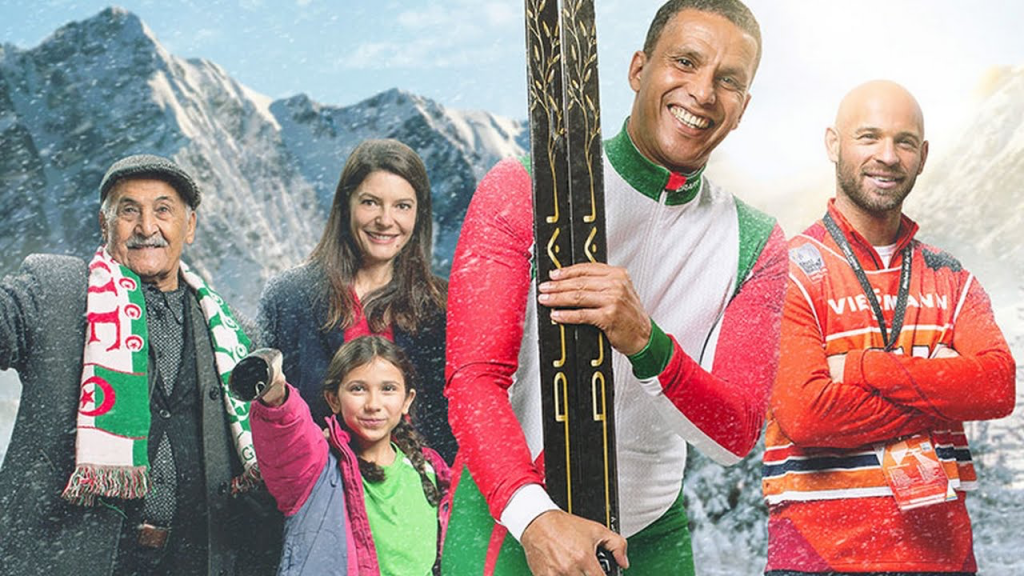
French sports films that deal with issues such as the legacy of colonialism often focus primarily on reconciliation rather than posing searching questions about inequality. In these films, there are certain paternalistic elements and examples of the white saviour complex. In Farid Bentoumi’s Good Luck Algeria (2015), a French-Algerian skier works towards representing Algeria in the Winter Olympics and is aided in his quest by a white French colleague who lacks any evident foreign roots. In Les Invincibles, the French-Algerian pétanque player Momo (played by Atmen Kelif) is aided by an older white French bowler played by Gérard Depardieu.
Within these films, American sports films and sportspeople are sometimes referenced. Several feature nods towards the iconic Rocky films in which Sylvester Stallone plays a fictional boxer from Philadelphia.
If French sports films don’t have a direct equivalent to the American Dream narrative which is prominent in Hollywood sports films, this owes much to France’s differing political history. The French constitution is based on the idea that people gain rights as individual citizens rather than as members of groups defined by criteria such as race or ethnicity. Concepts such as republican universalism or the single and indivisible republic do not easily or neatly lend themselves to the sort of aspirational narratives present in feel-good tales.
Dr. Jonathan Ervine is senior lecturer in French and Francophone Studies at Bangor University. Find him on INSTAGRAM, X or BLUESKY.
He is the author of the forthcoming book French Sports Films: Visions of Masculinity, published by Routledge and due out on 18 December 2025 – Find it HERE
 Cinema and Social Justice PROJECT
Leave a comment