

Rebecca Siddall
As we enter 2026, queer and trans reproduction remains all but invisible in media, and LGBTQIA+ rights are under threat worldwide. Viewing Juno – a film about a heterosexual, cisgender, pregnant teenage girl – 20 years after its release means re-evaluating almost every one of its details. In a recent interview, screenwriter Diablo Cody invites us to do exactly that: to rewatch her film through a queer lens, leading to a ‘radical reimagining of teen pregnancy’ [1].
Cody’s perspective on Juno is often one of regret. The film has drawn criticism for its casual homophobic jokes (baby names are rejected for sounding ‘too gay’) and its ambiguous representation of reproductive rights: protagonist Juno rejects abortion after talking to a pro-life protestor. Cody admits that she wrote an apolitical narrative largely out of fear of backlash, urging viewers to read between the lines. In the present, she has bluntly stated that she would prefer not to have made the film at all than to watch it be misused by anti-abortion advocates [1].
Lead actor Elliot Page has also been moved to re-examine Juno. Page (who now uses he/they pronouns) first came out as a lesbian in 2014, and then as trans, non-binary, and queer in 2020 [2]. He describes the outside pressures of a homophobic and sexualised film industry: the production company forced him to wear hyperfeminine outfits on the press tour, which ‘literally did almost kill me’ [3]. But on set – despite playing a pregnant teenage girl and wearing a fake belly – Page did not feel objectified or hyperfeminised. Instead, he felt able to infuse Juno with elements of his queerness and transness, which we can see in the character’s unapologetic individuality and androgyny. For the first time, Page felt comfortable making a film as himself, and in turn, being himself: ‘Juno was emblematic of what could be possible, a space beyond the binary.’ [4].
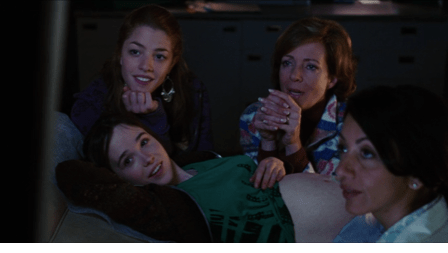
Through Juno’s apolitical shell, we can see touches of a truly queer film. Most notably, every relationship between characters resists simplistic definition. Juno’s awkward love interest – and the baby’s father – Bleeker (Michael Cera) is sidelined in favour of her best friend Leah (Olivia Thirlby). Leah is truly Juno’s partner: the first person to whom Juno reveals her pregnancy, the person who’s there at every scan and at the birth holding her hand. Arguably, the real love story is between Juno and Leah, and their obvious connection is made all the more touching by Page’s recent revelation that he and Thirlby were in a relationship while filming; Page even credits Thirlby as having inspired him to overcome internalised homophobia [4]. The film’s iconic soundtrack also subtly decentres the central heteronormative relationship by prominently featuring ‘Anyone Else but You’ by The Moldy Peaches; an indie hit which the band has branded ‘a platonic love song…taking love from a little bit of another dimension’ [5].
Non-normative kinship is another theme that quietly runs through the film. When Juno decides she can’t go through with abortion, Leah tracks down would-be adoptive parents Vanessa (Jennifer Garner) and Mark (Jason Bateman). Juno’s trust of Vanessa grows throughout the film, and ultimately she chooses Vanessa to adopt her child even after Vanessa and Mark have divorced, subverting heteronormative expectations of parenting. Juno’s relationship with her father’s wife Bren (Allison Janney) is also refreshing – far from the “evil stepmother” trope, Bren treats Juno as her own daughter and supports her through pregnancy, childbirth, and adoption. Juno’s father Mac (J.K. Simmons) is generally supportive, but notably is the only one to criticise Juno after she reveals her pregnancy, remarking ‘I thought you were the kind of girl who knew when to say when’. Juno, visibly emotional, replies ‘I don’t know what kind of girl I am’ (0:25:57). This moving statement can be read as reflective of narrow societal expectations of reproductive experience, with queer, trans, and non-binary reproductive lives rendered invisible.

Watching Juno through a queer lens is ultimately, as Cody describes, a radical act. “Queering” reproduction goes beyond practical actions like advancing fertility technologies or introducing same-sex parent legislation (although both are crucial): it is, at heart, about re-evaluating everything we have been taught to think about pregnancy and parenthood. This act of re-evaluation should include existing cultural artefacts. Even as they are rooted in their specific times and places, films have a transcendent quality conveyed through the eyes of the viewer. When we queer films, we are exploring how they are socially constructed to reinforce cis-heteropatriarchal values, and how a queer political lens might allow us to undo these biases. A queer reading of Juno demands a reassessment of its apolitical standpoint, but done right, we can hold these regressive qualities in mind while also recognising the undertones of a truly emotional queer and trans reproductive storyline. A radical, deliberate decontextualisation allows us to see Juno as one of the very few examples of queer reproduction on screen.
Rebecca Siddall is a Second Year PhD student at Anglia Ruskin University. Her research combines intersectional feminist, queer, and disability theory methodological frameworks to explore how reproductive abuse (coercion around pregnancy, abortion, contraception, and sterilisation) is presented in contemporary media. She has an MSci and BA from the University of Cambridge, with a specialism in the history and politics of reproduction.
Find Rebecca on LinkedIn here and read her blog ‘Repro Rights’ here.
Notes
[1] Brown, E.N. (2022) ‘Diablo Cody Meditates on “Juno” and Its Critics 15 Years Later: “I Am Emphatically Pro-Choice”’, The Hollywood Reporter, 15 July. Available at: https://www.hollywoodreporter.com/movies/movie-news/juno-movie-15-years-later-diablo-cody-roe-1235178240/
[2] Donnelly, M. (2020) ‘Oscar-Nominated “Umbrella Academy” Star Elliot Page Announces He Is Transgender’, Variety, 1 December. Available at: https://variety.com/2020/film/news/elliot-page-transgender-ellen-page-juno-umbrella-academy-1234843023/
[3] Esquire (2022) ‘The Euphoria of Elliot Page’, 1 June. Available at: https://www.esquire.com/entertainment/tv/a40011366/elliot-page-umbrella-academy-euphoria/ (Accessed: 15 December 2025).
[4] Page, E. (2024) Pageboy: A Memoir. London: Transworld Publishers Ltd.
[5] Moldy Peaches – Anyone Else But You | Song Stories (2019). Available at: https://www.youtube.com/watch?v=S87bAjx4Aww

 Cinema and Social Justice PROJECT
Leave a comment