
Adam Field
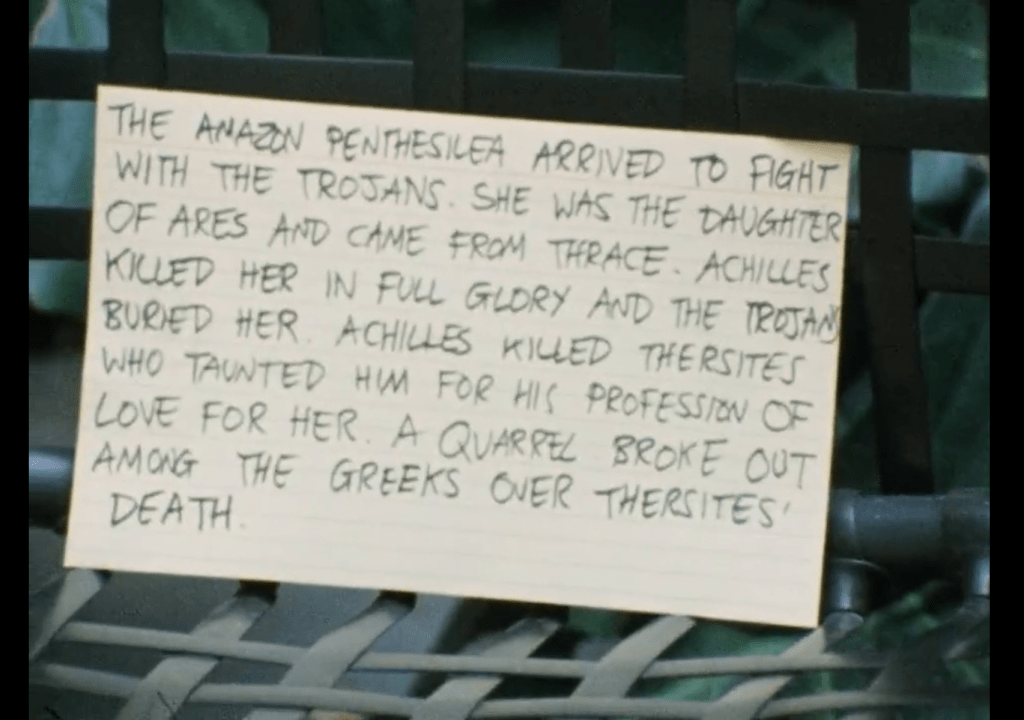
There’s a striking moment in Laura Mulvey’s first film Penthesilea: Queen of the Amazons (1974) in which the camera seems to float away from her co-director (and then-partner) Peter Wollen as he walks around the garden of an empty house delivering a lecture on the mythical Amazon queen and patriarchal myths of warrior women. Wollen follows the camera back into the house as the camera itself then wavers and wanders before settling on a cue card, allowing the spectator to read the script that Wollen himself has just read from. Mulvey and Wollen’s experimental documentary style constantly draws attention to itself, subverting the traditional documentary mode by exposing its artificial, constructed nature.
Released a year before her groundbreaking article ‘Visual Pleasure and Narrative Cinema’ would appear in the journal Screen, Penthesilea would – like Mulvey’s other films – shortly be overshadowed by the seismic impact of her written work.While Mulvey remains known one of the most influential figures in feminist film theory, her films have received comparatively little attention, yet they contain the same radical feminist themes that made her academic work so popular.
Riddles of the Sphinx, released in 1977, is the clearest cinematic representation of the ideas which Mulvey formulated in ‘Visual Pleasure.’ Rather than trying to replicate the classical Hollywood style and appropriate it for feminist purposes, the film is an avant-garde construction in seven parts, many of which bear little if any relation to one another. In the second part, Mulvey speaks directly to camera in a style similar to that of Wollen in Penthesilea, referring to the parts of the film that will follow and explicitly stating their interest in exploring the relationship between gender and mythology. “Everybody knows that Oedipus killed his father and married his mother,” she states, “but the part played by the Sphinx is often overlooked.” For Mulvey, the Sphinx is a figure who unsettles knowledge, continually asking questions which “disorder logical categories,” as she puts it.
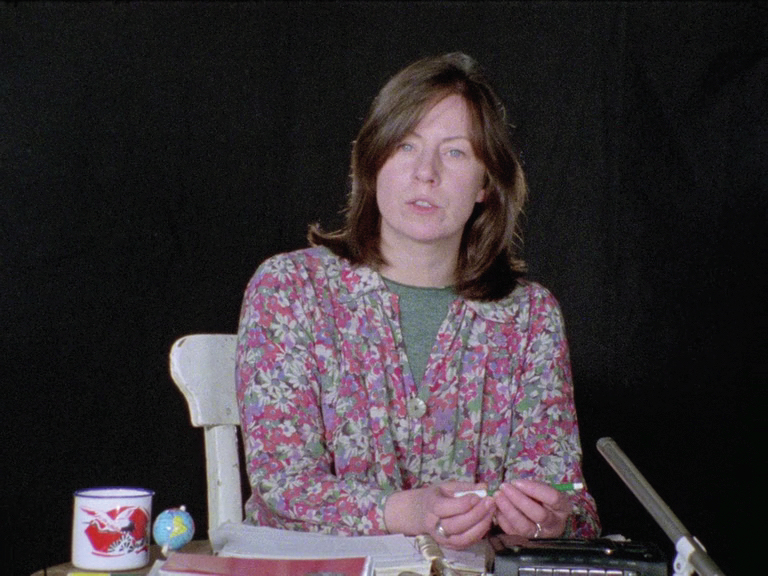
After drawing parallels between the place of the Sphinx in Greek mythology and the place of women in patriarchal society, in the closing moments of her lecture she bluntly states that we live in a society ruled by the father, in which the mother can only be heard as “a voice apart, a voice-off.” The longest section of the film, a loosely connected narrative filmed in 360-degree panning shots, ingeniously attempts to portray this “voice-off” cinematically. This section is narrated by a Sphinx which seems to both contain the voices of all the women within the diegesis and speak apart from them entirely. At times it speaks about the characters, at other times it seems to speak directly to the viewer, asking a series of questions about the place of motherhood in patriarchy. The following sections – one of a gymnast performing, the other of Mulvey fiddling with a tape of her earlier speech – lack any clarification or conclusion, inviting the viewer to reflect on the questions raised rather than providing any answers.
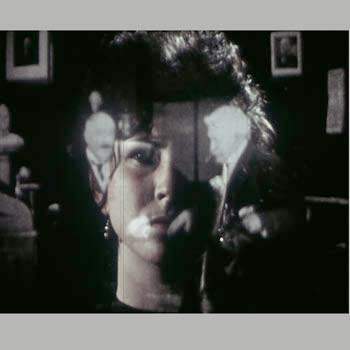
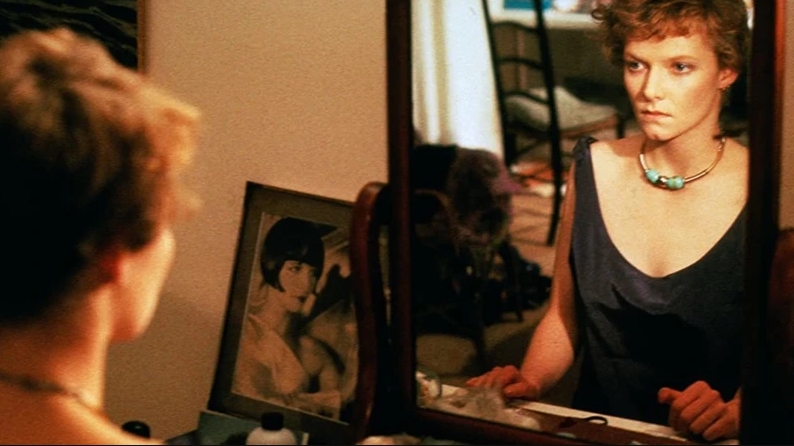
Many of Mulvey and Wollen’s later films turned to an engagement with other female artists, writers, and cultural figures. 1980’s AMY! is an experimental essay film about the pilot Amy Johnson, and 1983’s Frida Kahlo & Tina Modotti functions as a kind of comparative biography about two influential figures in the Mexican renaissance. The Bad Sister(1983), an adaptation of the novel by Emma Tennant, is a fantastical crime mystery which contains a narrative far more conventional than their other films, yet is full of formal subversions. The film plays with digital effects to explore psychoanalytic themes of self and other, masculine and feminine, visualising a dreamlike unconscious.
Where Mulvey’s theoretical work set out to describe the patriarchal structure of mainstream cinema, her own films propose alternative ways of looking, of thinking, of relating to film. ‘Visual Pleasure’ calls for a cinema of “passionate detachment,” a cinema which frees the spectator from the coercive structures that have characterised cinema, not by replacing these structures with a more progressive equivalent but by demolishing these structures altogether. Mulvey’s own radical feminist experimentations offer an example of what such a cinema might look like.
 Cinema and Social Justice PROJECT
Leave a comment