
Peter Krämer
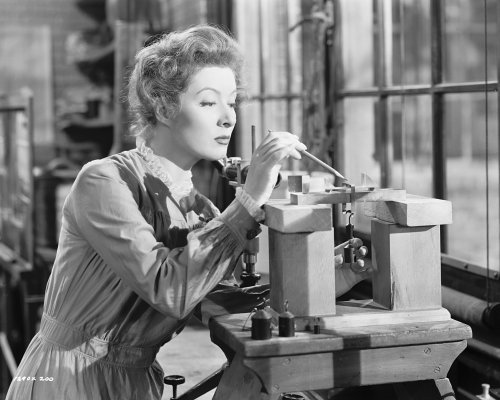
Madame Curie (1943) was the first ever Hollywood movie about a major female scientist. Indeed, the film’s subject is the most famous of all female scientists, and the woman playing her in the film was Hollywood’s biggest star at that time.
Born in 1867 in Warsaw as Maria Salomea Skłodowska, the woman who came to be universally known as Marie Curie was not allowed to enrol at a regular Polish university and instead attended an underground educational institution. In 1891 she moved to Paris, where she studied physics, chemistry and mathematics at the Sorbonne. She shared a laboratory with the French physicist Pierre Curie whom she married in 1895.
Curie was the first woman ever to win a Nobel prize, and she is still the only person to have won two Nobel prizes in different scientific disciplines, for physics in 1903 and for chemistry in 1911. The first of these prizes was for work on radiation emitted by unstable chemical elements. The second was for the discovery of two new chemical elements.

Because of her Nobel prize winning work and many other accomplishments (not least as a practical pioneer of medical radiology), Curie is widely regarded as a truly outstanding scientist. When Discover Magazine in 2023 ranked the ten greatest scientists of all time, Curie came in second place after Albert Einstein.
The first biography, entitled Madame Curie and written by her younger daughter Ève, was published in 1937, three years after she had died as a result of a blood disease caused by exposure to radiation during her research. The film rights were snapped up by Hollywood, which had had enormous success with biopics in the 1930s. MGM’s big-budget adaptation was a box office hit being nominated for seven Academy Awards, including Best Picture, Best Actor and Best Actress.
The film’s title role was played by Greer Garson. Born in the UK in 1904, Garson was a well-established stage actress in England when MGM signed her in 1937. For her very first film, Goodbye, Mr. Chips (1939), she received a nomination for the Best Actress Oscar and from 1941 to 1945 she was nominated every single year, winning the Best Actress Oscar for Mrs. Miniver (1942). In Quigley’s annual poll of American film exhibitors Garson was ranked as one of the top ten ‘Money-Making Stars’ every year from 1942 to 1946.
Madame Curie is the third film in which Garson was teamed up with Walter Pidgeon, and she always received top billing. This is indicative of a wider trend where many of the biggest hits at the US box office after the country’s entry into World War II in December 1941, centred on female characters, with the actresses playing them billed ahead of their male co-stars.

The bias in hit movies from 1942 to 1946 towards female characters and female stars is related to the fact that the American cinema audience was heavily weighted towards women, because more than seven million American soldiers, over 10% of the male population, were stationed abroad, and many of them did not return until late in 1946. In fact, by the 1940s Hollywood had long considered women as its most important audience, to which it catered specifically with films featuring women in a lead role, particularly romantic comedies, musicals and dramas.
With its focus on a female protagonist, historical costumes, romance, marriage and family life as well as terrible loss (the early death of Curie’s husband), Madame Curie is typical for the kind of film Hollywood made with women audiences in mind. But it also puts a twist on conventional situations and relationships. A beautiful woman finds herself all alone in a world of men, initially with no romantic pursuit in sight. An absent-minded scientist gradually changes his mind about women; rather than being the enemy of science, he comes to recognise that one of them is essential for his work. His marriage proposal equates matrimony with a scientific collaboration.

The film explores the nature of scientific work in some detail, emphasising the importance for scientific progress of not being satisfied with conventional wisdom. There is also a strong focus on the frustrations, doubts and arduous labour of science, on all the resources needed for it, on years of lab work before a daring hypothesis can be confirmed.
Finally, there is the idea that a scientist like Marie Curie does not simply want to gain a better understanding of the world but also wants to use her scientific insights to make the world a better place. However, as the movie Oppenheimer has recently reminded us, the insights of basic research in science can also make the world a much more dangerous place, and Marie Curie contributed to this by helping to lay the foundation for nuclear physics and thus for the development of the atomic bomb.
 Cinema and Social Justice PROJECT
Leave a comment