

by João Pedro Soares
Have you ever seen a war film like The Thin Red Line? Premiered in 1998 by director Terrence Malick, the film portrays the infamous Battle of Guadalcanal, one of the most destructive campaigns in the Pacific during WWII. But, surprisingly, The War is confined to the background, making it a unique film within the war genre. Here is why:
The depiction of the Battle of Guadalcanal is created from an anti-military POV, and the representation of the soldiers takes into account a ‘collective soul’ to the detriment of the individuality of each character. The focus of the story lies on the internal conflict of that group of men; their thoughts and feelings, and above all, on the figure of Witt (played by Jim Cazievel) and his poetic and existentialist questions during the conflict.
‘the sadness and uselessness of war are constantly challenged by the immense beauty of nature’
The film builds a contrast between war as an ‘evil’ event and nature as a something ‘pure’. This is seen through the long sequences shot in forests, close-ups of vegetation, and through the soundtrack which regularly refers to the sounds of birds and wind, instead of the more expected explosions or gunshots. Bersani and Dutoit in Forms of Being suggested that “[…] we do not see a war “in the heart of nature”, but rather a war brought into the heart of nature by men.” This is fundamental to understanding the importance of The Thin Red Line in comparrison to other war films, as nature in this film is the main character. Contrary to what is observed within the war genre, nature is not down played, it is foregrounded either through scenes that highlight its wonder, or by the protagonist’s constant remarks about the natural world.
Witt embodies an environmental consciousness that pervades the entirety of the narrative, through his eyes we see different details of nature and animals. His philosophical voiceover empowers the natural world with a sense of the divine, as one can see in his prophetic final sentence: “All things shining…”. This enigmatic phrase is a call for environmental consciousness that reconfigures a different stance towards the natural world.
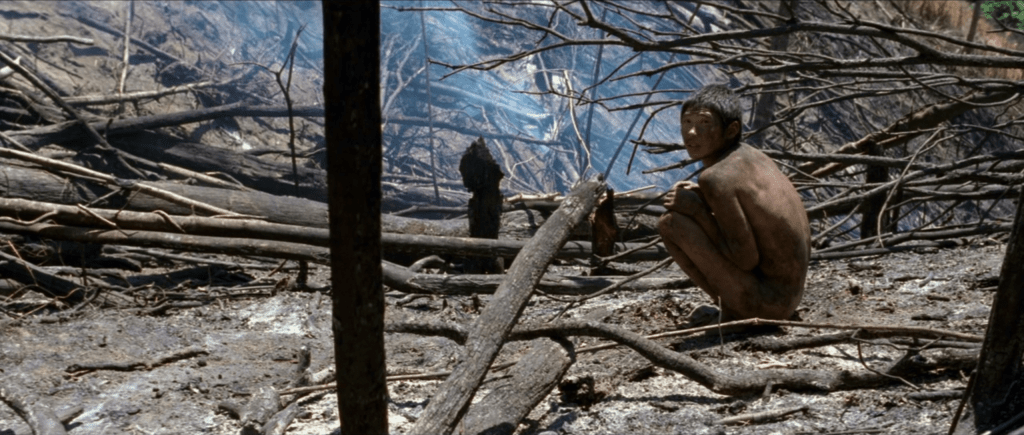
In The Thin Red Line, the sadness and uselessness of war are constantly challenged by the immense beauty of nature, its infinite wisdom and mystery, in such a way that the main character seems completely obsessed – or possessed – by its mesmerizing power. Witt seems to intend, through his actions and points of view, an ascent to this natural state, to this absolute and harmonious presence with the world.
In this sense, the film is atypical for the war genre, offering a unique perspective. If we understand that the natural environment is responsible for our existence, and war destroys both nature and humanity alike, we humans can question the consequences of military conflict, and its impact on the earth system. Thus, Malick’s film, by depicting war in an introspective manner, indirectly refers to this notion, raising awareness for us to think about the implications of armed conflicts, and by extension about the current state of the Solomon Islands following the warfare.
Thousands of wrecks of ships and planes are lost in the waters of the Pacific, both becoming an environmental and a political problem, as the nations involved in the conflict should bear the consequences of the results of their actions, acting not only politically, but, above all, environmentally. In this case, it would be up to the governments of the United States of America and Japan to assume the costs of cleaning up this region, particularly around the island of Guadalcanal, where the largest and most intense part of the conflict occurred. But tragically, the ecological problems do not only remain at sea, with the risk of thousands of litres of oil and chemical weapons being spilled, there is also the danger on land; the island of Guadalcanal and by extension the Solomon Islands, are infested of mines and other types of explosive devices, also originating from the American and Japanese presence in the area.

Any political agenda that actively tries to clean up the war pollution brought to this area during WWII remains to be seen, but the importance of Malick’s film as an anti-war statement solidifies the ability of film to question existence, and in this case, humanity’s relationship with the natural world, the consequences of armed conflict in ecosystems, and the urgent need to demand social justice and reparation to Guadalcanal and the Solomon Islands.
João Pedro Soares is a PhD candidate in Artistic Studies at The Portuguese Faculdade de Ciências Sociais e Humanas. You can find him on Instagram HERE


Leave a Reply