
Sarah Barrow, Maria Eugenia Ulfe & Eylem Atakav
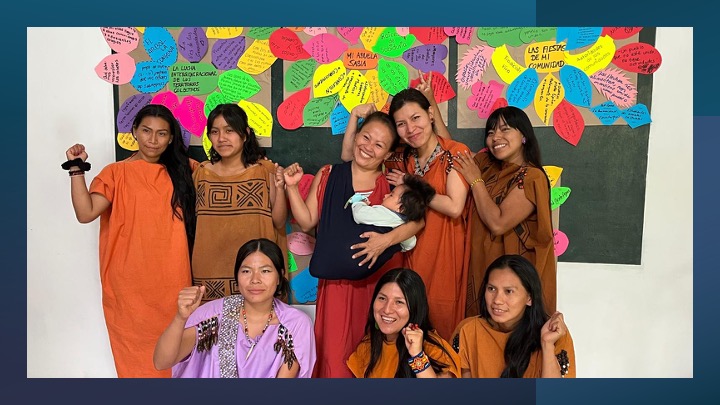
“We are young and adolescent Asháninka and Yánesha women, granddaughters of the indigenous warriors that resisted in an organized manner in our ancestral lands in the Selva Central of Peru. Today, our families, our wise women and mother nature herself give us the energy and knowledge we need to shed light on the damages and discrimination that we suffer. The difficulties that affect each of our communities move us to take this opportunity to raise our voices so that we are heard and we can defend our rights.”
So begins the manifesto created by the young women of OMIAASEC (organization that defends the rights of indigenous women of the central Amazonian region of Peru) during the second fieldwork visit of the Women of Influence | Mujeres Que Influyen project. Our collective starting point, informed by their leader Ketty Marcelo, has been that while women play a fundamental role in the preservation of biodiversity and ancestral knowledge, their contributions often go unrecognized.
Since launching the project in 2020, this project has sought to understand and make visible the work that these young women undertake as community members and emerging leaders. Through mobilizing film literacy and production, we have worked to support their ambitions, expand their networks, enhance their visibility and further their spheres of influence in the context of environmental, social, cultural and political risk.
Dissemination as awareness-raising and knowledge-exchange has been a crucial dimension of the project. We have also supported the young women to share their films amongst stakeholders. Starting with community events and extending to authorities, civil society representatives, educators, journalists and other activists based in Peru, the UK and at COP, we recognize in film the capacity, as cultural intermediary, to attract public attention to issues that even NGOs find it hard to concentrate minds on. (Elsaesser 2005; Falicov 2016)
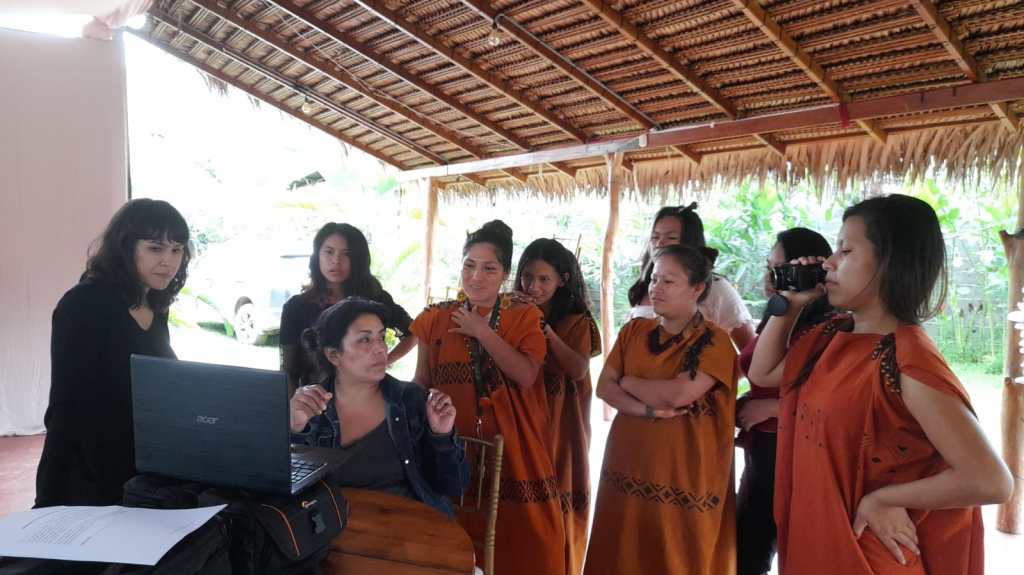
The evolution of gender roles in the context of the Ashaninka and Yanesha people has been vital to understand. In the main, the men have long been responsible for hunting and food gathering, while the women are responsible for food preparation, childcare and making handicrafts. (Varese 2006).
The traditional social organization of the Ashaninka and Yanesha likewise used to include differentiated leadership roles. The pinkathari was the head of the family clan, whose function was the care of the territory and the resolution of conflicts between members of the group (Rojas Zolezzi 1994). The Sheripiari was the spiritual leader, who could communicate with the spirits and guarantee the welfare of the group (Rojas Zolezzi 1994). Since the 1970s, new forms of leadership emerged, with new skills requirements, including literacy and numeracy, and negotiation with external actors (Green 2009). While these leadership roles used to be exercised mainly by men, in recent decades, factors such as the internal armed conflict between State and Shining Path and economic-related migration of young men away from their communities, have generated new responsibilities for women as leaders (Paredes Piqué 2004). With much younger women showing interest in this work, new opportunities for raising wider visibility via film and media literacy of the specific challenges they face have also emerged.
Our project has aimed to contribute to their work, using film [production and exhibition] as vital ‘tool of feminist engagement’ (Harman 2019, 24), as method for community activism and as effective medium of knowledge exchange. We adopted the approach of collaborative co-production as a political choice, with the intent of giving voice directly to the subjects whose issues we might otherwise write about, deliberately blurring the boundaries between researchers and community partners, aiming to address power imbalances. As such, we have sought to develop a media project that ‘emphasizes transformation through action-based research’ (2019, 25).
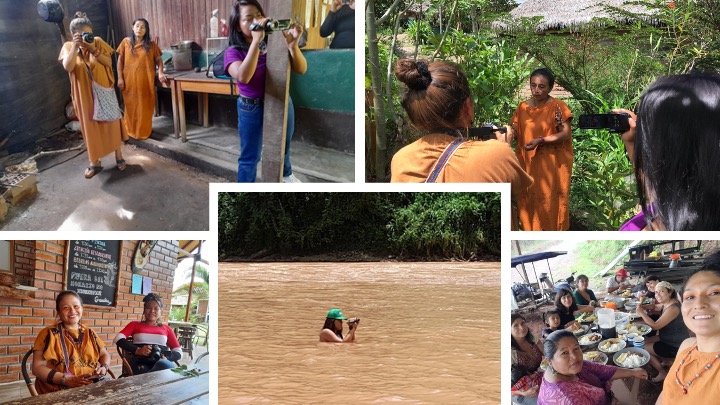
Together we created a package of five short documentary films as an alternative manifesto. More specifically, these films were co-directed by the young women with our support. Each short film highlights an issue of concern to the young women, as articulated by them through pre-production workshops: scarcity and unequal access to water; loss of cultural traditions and knowledge; the importance of sharing food, farming methods and recipes; the threat of waste and pollution on their livelihoods; the challenges of facing discrimination as young Indigenous women. Through these films, otherwise marginalized voices have had the chance to be heard, images of vital importance to them can be seen, and action is directed where it is most needed.
PI: Sarah Barrow is Professor of Film and Media at University of East Anglia. She has, for over 3 decades, written about Peruvian cinema and culture. Through this project, she has been privileged to engage via film more directly with a group of young Peruvian women whose voices deserve to be heard.
Co-I: Maria Eugenia Ulfe is Professor of Anthropology at Anthropology at the Department of Social Sciences at the Pontificia Universidad Católica del Perú. Her specialisms include memory and democracy, gender, ethnicity, and violence, and experimental visual ethnography.
Co-I: Eylem Atakav is Professor of Film, Gender and Public Engagement at University of East Anglia. She has written about women in Turkish cinema and produced 4 documentaries on issues relating to marginalized women in the UK and Turkey.
 Cinema and Social Justice PROJECT
Leave a comment